

The right beginning in crypto defines everything

Entering the world of cryptocurrencies is not merely a technological decision. It is, above all, a structural one. In this in-depth guide, you will understand why how you choose your first cryptocurrency platform directly shapes your security, your understanding of the ecosystem, and your ability to grow with consistency over time. This article outlines the most common mistakes beginners make, presents objective criteria for evaluating platforms, and connects early decisions to long-term practical consequences, all in clear, accessible, and instructive language.
Why the first platform you choose shapes your entire journey
When someone decides to begin in crypto, attention usually gravitates toward prices, volatility, and potential gains. This initial focus is understandable, yet it often distracts from what truly sustains a healthy long-term experience: the structure of entry. In crypto, your first platform functions as an educational environment. It is where you learn how wallets operate, how transactions are processed, how fees are calculated, how contracts work, and how risks unfold. If that environment is confusing, fragmented, or opaque, the learning process is compromised from the outset.
In practice, many beginner mistakes in cryptocurrency do not stem from a lack of intelligence or curiosity, but from a lack of context. Platforms that prioritize rapid execution without clarifying processes inadvertently push users toward poorly understood decisions. Over time, this breeds insecurity, frustration, and in many cases, disengagement from the ecosystem. Starting well means starting with understanding, and that depends directly on the structure provided by the first platform you choose.

Click here to view the infographic in full screen
The most common beginner mistake: confusing access with understanding
One of the most recurrent misconceptions when entering crypto is assuming that ease of access equals ease of comprehension. Creating an account in minutes, purchasing an asset quickly, and watching numbers fluctuate on a screen may feel like progress, but it does not mean you understand what is truly happening. Many platforms are designed to reduce operational friction, not to cultivate progressive understanding. For beginners, this is a subtle but significant risk.
When a platform fails to clearly explain concepts such as custody who controls the keys actual transaction fees, or the distinction between available and locked balances, users operate in the dark. This scenario is increasingly common across regions where adoption outpaces digital financial education. Beginning in crypto securely requires more than speed. It requires structural clarity from the very first interaction.
Objective criteria for choosing your first cryptocurrency platform
Making a sound choice does not rely on guesswork, but on clear criteria. Before creating an account, consider a few essential elements. Transparency comes first: rules, fees, and processes must be visible and intelligible. Second, educational structure: does the platform help you understand what you are doing, or does it simply execute commands? Third, operational predictability: do you know what will happen before, during, and after each action?
It is also important to assess whether the platform is intentionally designed for beginners or merely tolerant of them. Overly technical interfaces without explanatory layers may discourage users over time. These criteria apply globally, regardless of country, and allow you to filter options without relying on promotional rankings or generic recommendations.
Common beginner mistakes in crypto and how to avoid them from the start
Among the most frequent errors are operating without understanding fees, ignoring the distinction between self custody and platform custody, and assuming all platforms function in the same manner. These missteps do not arise from negligence, but from insufficient initial guidance. When platforms fail to contextualize decisions, users learn only after making mistakes.
Avoiding these pitfalls begins with carefully reading the rules and selecting an environment that encourages comprehension. Platforms that provide simulations, explain consequences, and issue warnings before irreversible actions help reduce common errors. In both mature and emerging markets, this approach has proven to be a meaningful differentiator in sustaining a positive beginner experience.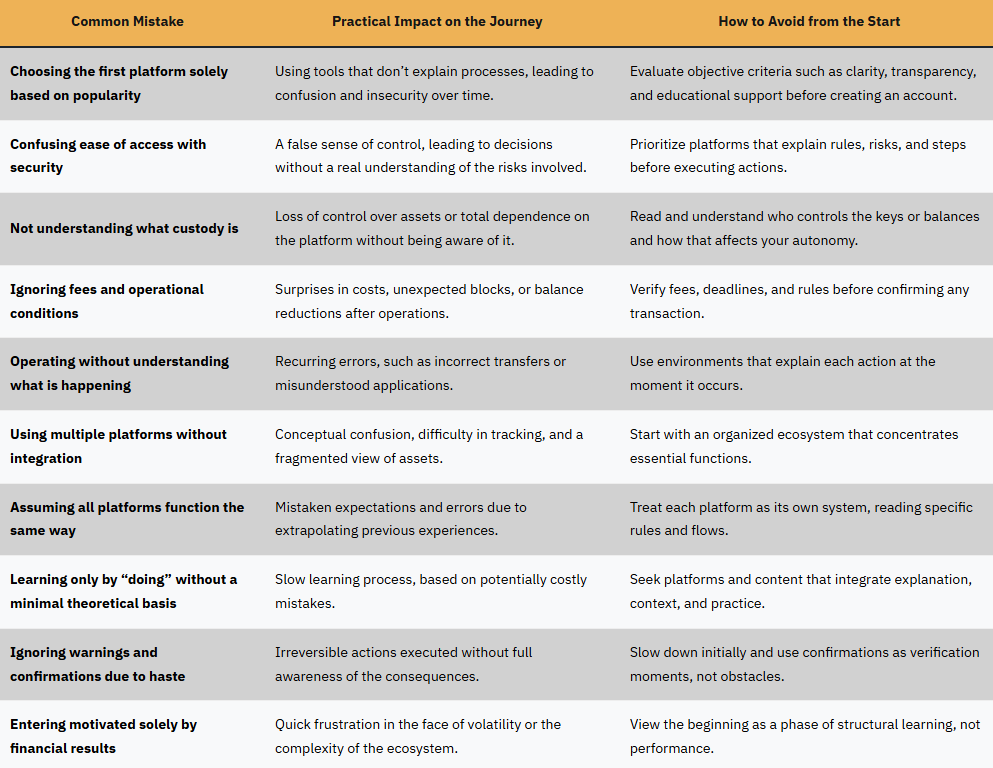
Click here to view the image in full screen
The right beginning determines what follows
Throughout this guide, it has become clear that entering the crypto world is not simply an act of curiosity or technical access. It is a structural decision. The starting point shapes how the ecosystem is understood, how risks are perceived, and how opportunities are approached over time. Many issues commonly attributed to the crypto market itself originate, in reality, from poorly structured beginnings lacking clarity, mediation, or integration.
Starting well does not mean eliminating risk, but understanding it. It means having organized tools, accessible information, and sufficient support to evolve progressively. When the foundation is solid, learning accelerates, errors diminish, and the experience shifts from reactive to deliberate and strategic.
At this stage, choosing your first platform ceases to be a minor operational detail and becomes a defining decision that influences your entire journey. Structure, clarity, and guidance are not optional features. They are fundamentals.
If you wish to begin or reorganize your crypto journey with greater clarity and security, explore the Inkryptus ecosystem. Discover the integrated solutions and see how to start with structure from your very first interaction.
References
World Bank 2022
OECD 2021
NIST 2020
Public reports from central banks on digital financial education 2019 to 2023